SDGs+Beyond Future Society for Life Week
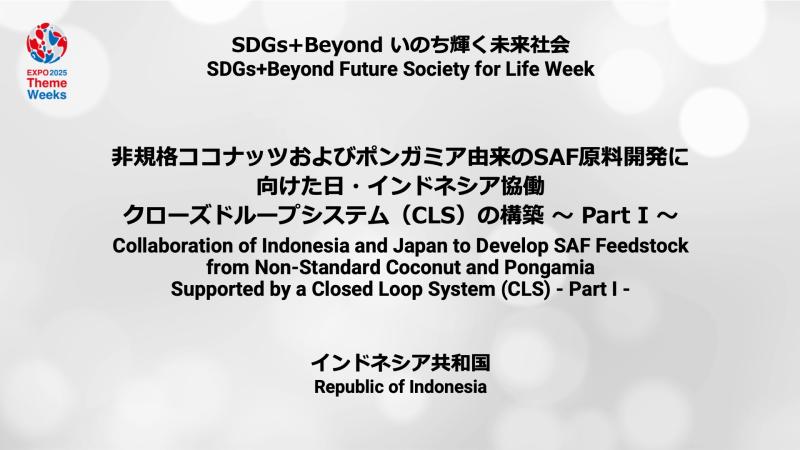
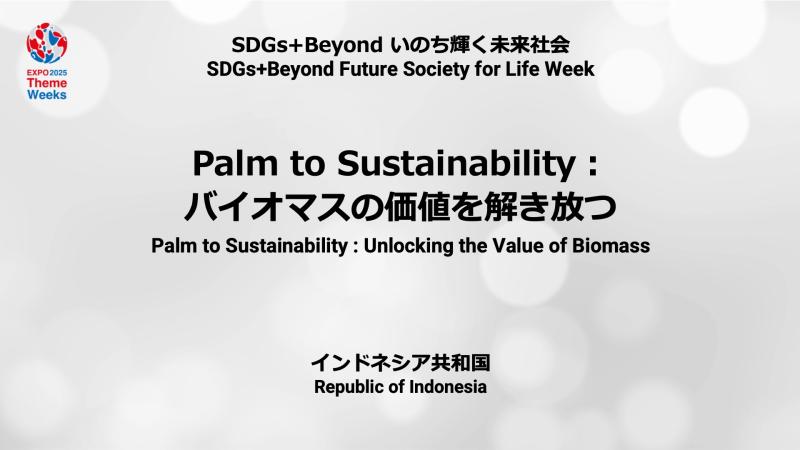
Collaboration of Indonesia and Japan to Develop SAF Feedstock from Non-Standard Coconut and Pongamia Supported by a Closed Loop System (CLS) - Part II -
Republic of Indonesia
This programme presents initiatives aligned with the Carbon Offsetting and Reduction Scheme for International Aviation (CORSIA), a global framework for reducing and offsetting CO₂ emissions from international aviation. In Japan, the aim is to maintain total CO₂ emissions from international flights at 2020 levels through to 2035, with a target SAF utilisation rate of 10%. Indonesia has set a target of 5%.
Achieving these targets requires both active implementation and a stable supply of SAF feedstocks. This programme highlights the use of non-standard coconuts and pongamia as SAF feedstocks within a Closed Loop System (CLS), demonstrating how effective resource utilisation can be combined with sustainable fuel production.
Recorded video available
Discussion
- #Eco-friendly Fuel
| Transmission of simultaneous interpretation | Provided |
|---|---|
| Language of interpretation | To be determined |
-

Track Programme
- Time and
Date of
the event -
-
2025.10.09[Thu]
16:00 ~ 18:00
(Venue Open 15:30)
-
- Venue
- Pavilion
- Indonesia Pavilion
Programme details
*Subtitles: Choose “Subtitles/CC” in the “Settings” (gear icon) at the bottom right of the YouTube video.
*Subtitles may not show with multiple languages or overlapping audio.
The programme will be conducted online. It begins with an introduction of the Coconut Crude Oil (CCO) processing plant project, derived from non-standard coconuts. Construction is scheduled to start this year, with operations expected by the end of next year, in coordination with existing CCO plants to establish a reliable SAF feedstock supply chain.
Since non-standard coconuts alone are insufficient, pongamia and tamanu (terihaboku) will also be cultivated, with planting commencing this year in Central Kalimantan. These efforts aim to showcase Indonesia’s abundant SAF feedstock resources and their potential for sustainable fuel production both domestically and internationally.
The programme is divided into two sessions, featuring presentations and discussions by government officials, researchers, and private sector representatives. Participants, including investors and energy and fuel sector stakeholders, will gain insights into the latest developments in sustainable aviation fuel, investment opportunities, and prospects for international collaboration.
Reports
【Reflection】
The afternoon session provided participants with an opportunity to deepen their understanding of SAF development using local resources in Banyuasin Regency, South Sumatra, Indonesia, as well as the cooperation framework between Indonesia and Japan. Five speakers from both countries presented concrete initiatives, including the utilisation of non-standard coconuts as an agricultural resource and plans for constructing CCO (crude coconut oil) factories. While non-standard coconuts are not suitable for food use, they hold promise as a raw material for SAF, contributing to resource efficiency and waste reduction. Alternative raw materials such as Pongamia and Nyamplung were also discussed, highlighting the potential for sustainable biomass supply from underutilised resources.
Banyuasin Regency has extensive farmland and water areas along its rivers, with active cultivation of palm oil, rubber, and coconuts. The local government is facilitating CCO factory construction by improving infrastructure and streamlining permitting processes, helping to lay the foundation for a sustainable industrial cluster through public-private collaboration. In addition, the provincial government has introduced a Closed Loop System (CLS) to promote zero-waste, circular production, with an expected annual utilisation of approximately 2 million tons of non-standard coconuts. This system, which circulates resources from raw materials to finished products, is considered instrumental in establishing a sustainable industrial model.
The environmental initiatives of PT Sasa Inti were also highlighted. Through the reuse of waste, wastewater treatment, and CSR activities such as education and health support for local communities, the use of non-standard coconuts and the construction of CNO (coconut natural oil) factories are expected to enhance economic value and promote regional employment. Furthermore, Japan’s Space Tech Accelerator is supporting farmland monitoring and certification using satellite technology, enabling sustainable sourcing, strengthened traceability, early detection of plant diseases, and validation of raw material selection and farmland management in accordance with international standards.
Overall, the afternoon session demonstrated that the industrialisation of non-standard coconuts, environmentally conscious production by local companies, satellite-assisted certification, and support from governments and international organisations are steadily advancing the formation of a sustainable SAF industry. These initiatives are expected to serve as an advanced model for revitalising regional economies, improving smallholder incomes, and balancing environmental conservation, playing a significant role in future green growth strategies.
【Post EXPO Initiatives】
Following the forum, relevant institutions in Indonesia and Japan have continued to advance concrete initiatives for the development of sustainable aviation fuel (SAF).
In terms of raw material management using non-standard coconuts, BRIN (Indonesian National Research and Innovation Agency) has taken the lead, working with the ICC (International Coconut Community) and IGBnet to develop a selection manual for non-standard coconuts. This manual categorises small, germinated, damaged, or decayed coconuts and is expected to be approved at the ICC Ministerial Meeting in November 2024. Once approved, certified training will be conducted in 2026 to cultivate internationally standardised selection technicians, contributing to the establishment of a sustainable SAF supply chain.
Local and provincial governments are also actively supporting the construction of CCO (crude coconut oil) factories. In Banyuasin Regency, access roads and streamlined permitting processes are being implemented to promote employment for local workers and collaboration with small and medium-sized enterprises. The provincial government has introduced a Closed Loop System (CLS) to promote zero-waste, circular production from raw materials to finished products, with an expected annual utilisation of around 2 million tons of non-standard coconuts. These measures are helping to establish a foundation for sustainable industrial cluster development through public-private collaboration.
The local company PT Sasa Inti has advanced environmentally conscious production activities, including the reuse of discarded coconuts, composting using black soldier fly larvae, wastewater treatment, and the construction of CNO (coconut natural oil) factories. Additionally, ongoing CSR activities, such as educational and health support for local communities, demonstrate the simultaneous pursuit of resource-circulating production and community-oriented industrial development.
On the Japanese side, the Space Tech Accelerator has provided satellite technology for farmland monitoring and certification support. This enables detection of land-use changes, illegal logging, progress monitoring of reforestation efforts, and early identification of plant diseases, contributing to sustainable sourcing and traceability. These technologies are also applied to support raw material selection and quality certification according to international standards, enhancing the reliability of the SAF industry.
Overall, initiatives such as the utilisation of non-standard coconuts, support for CCO factory construction, environmentally conscious corporate production, and satellite-based monitoring and certification are being steadily advanced post-forum, demonstrating that a sustainable SAF industry framework is taking shape. These efforts are expected to play a significant role in future green growth strategies as advanced initiatives aimed at revitalising local economies, improving smallholder incomes, and balancing environmental conservation.
*Part or all of this report was generated by AI.
Co-organiser
Indonesia Japan Business Network (IJBNet)
CMEA (Coordinating Ministry for Economic Affairs)
More Information
SDGs+Beyond Future Society for Life Week
Collaboration of Indonesia and Japan to Develop SAF Feedstock from Non-Standard Coconut and Pongamia Supported by a Closed Loop System (CLS) - Part II -
This programme presents initiatives aligned with the Carbon Offsetting and Reduction Scheme for International Aviation (CORSIA), a global framework for reducing and offsetting CO₂ emissions from international aviation. In Japan, the aim is to maintain total CO₂ emissions from international flights at 2020 levels through to 2035, with a target SAF utilisation rate of 10%. Indonesia has set a target of 5%.
Achieving these targets requires both active implementation and a stable supply of SAF feedstocks. This programme highlights the use of non-standard coconuts and pongamia as SAF feedstocks within a Closed Loop System (CLS), demonstrating how effective resource utilisation can be combined with sustainable fuel production.
-
2025.10.09[Thu]
16:00~18:00
(Venue Open 15:30)
- Pavilion
- * Programme times and content are subject to change. Any changes will be announced on this website and via the ticket booking system.
- * The schedule is subject to change depending on the organiser's circumstances.
OTHER PROGRAM
SDGs+Beyond Future Society for Life Week